The aim of RSE is to give young people the information they need to help them develop healthy, nurturing relationships of all kinds, not just intimate relationships. It should enable them to know what a healthy relationship looks like and what makes a good friend, a good colleague and a successful marriage or other type of committed relationship. It should also cover contraception, developing intimate relationships and resisting pressure to have sex (and not applying pressure). It should teach what is acceptable and unacceptable behaviour in relationships. This will help pupils understand the positive effects that good relationships have on their mental wellbeing, identify when relationships are not right and understand how such situations can be managed.” DfE Statutory Guidance for Relationships and Sex Education (RSE)
The Department for Education announced changes to Relationships, Sex and Health Education (RSHE). Such changes come into effect in September 2026, and all schools are required to comply with the updated requirements. This is currently under the latter stages of consultation which means that the PSHCE intent, content and implementation is being reviewed so we can be sure our provision is appropriate for our students based on their:
- Age
- Physical and emotional maturity
- Religious and cultural backgrounds
- Special educational needs and/or disabilities
You will be aware that, as a part of your child’s educational experience at HTCS, we aim to promote character education, personal well-being and personal development through a comprehensive programme of Personal, Social, Health, Careers and Economic (PSHCE) education that gives our students the knowledge, understanding, attitudes and attributes to live healthy, safe, productive and fulfilled lives, both now and in the future.
What does the new guidance mean?
The new RSE guidance for secondary schools emphasizes the importance of teaching young people about healthy relationships, contraception, and the use of accurate terminology for body parts. It also introduces topics such as online safety, personal safety around water, roads, and railways, and the recognition of new safeguarding risks caused by rapid technological developments. The guidance encourages a whole-school approach to wellbeing and positive relationships, linking RSHE to wider school policies and ensuring that the content is relevant and inclusive for all pupils.
How will this be delivered?
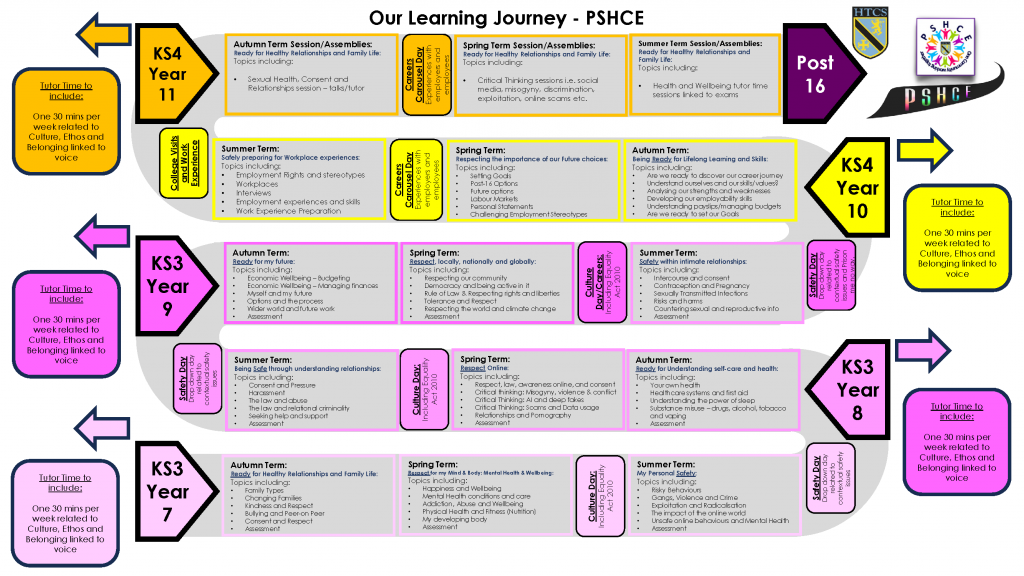
RSHE is delivered during as part of the PSHCE curriculum and wider areas. This guidance will form part of our school’s PSHCE education programme which is taught throughout the school KS3 lessons (one per-fortnight), drop-down days, tutor time activities and special 1-2 hour assembly-style sessions. This is monitored and reviewed regularly by the staff and Governing Body.
All teaching in PSHCE will take place in a safe learning environment and be underpinned by our school ethos and values. A variety of opportunities will be provided for students to ask questions to further their understanding and to find out more about what affects them personally.
What if I have questions?
To introduce parents to this concept and to ensure everyone is informed, we would like you to review the policy and the statutory content of the relationships, sex and health education programme. The policy also contains important information for parents who may wish to withdraw their children from sex education classes.
As a college community, we are committed to working with our parents and all feedback on the policy to support the consultation process would be fully appreciated. You can provide feedback on the policy by completing the survey at the bottom of this page or by emailing Mr John Leary: jleary@hightunstall.hartlepool.sch.uk.